Thursday, March 26, 2009

CrisisOfCredit.com

CrisisOfCredit.com explains it perfectly - with a very simple animated story:


(via @vineeth)

The creators of this video did not close the loop completely. The investors at the end who have lost the money - where does their money come from? The creators of wealth in any economy are the workers, at the bottom of the chain in our case. These workers - you and I - want to give our monies to these investors in the hope of getting back "more" "later". And we keep asking for more - from our pension funds, from our 401Ks, from our insurance plans. This money comes back to us when we take a loan or a mortgage, leveraged many times over. We validate the business model of these investors.

Essentially, everyone is borrowing money from the future because we are too greedy to sustain ourselves on what we have today.

Tuesday, March 17, 2009

mac & pc, pc & mac

It's interesting how the two brands have evolved.

PC stands for Personal Computer - a very generic term. Yet it has come to mean a computer running Windows. And Windows has captured the mindshare associated with personal computers. Mac, not meaning anything, has evolved from the opposite direction and has come to mean everything the PC is not. In doing so, it has captured the same mindshare associated with personal computers.

Sunday, March 1, 2009

books

I went and got myself a bookcase yesterday, and took my books from Bangalore out of their carton. I should have done this ages ago. There is something about having books around that makes the place feel more like home. Something old and familiar.

When I found only a handful of books in the carton, I realized just how many I have left behind. There was a brief moment of regret, but then, it's good to have space for newer books. I used to read a book a week; sometimes, more. This has steadily been decreasing over the years. I have just finished The Watchmen and as I try to think back to what I had last read, I see Atonement in my reading list on this blog on the left. That was 9 or 10 months ago! I have read Neil Gaiman's Sandman series since, but that's hardly a consolation.

Just got Friedrich Dürrenmatt's The Visit and The Execution of Justice. Wikipedia describes his works as "macabre satire"! I'm looking forward to reading these.


Saturday, January 31, 2009

man on wire

Phillipe Petit's style of narration draws you into his story - exactly as many other people with him in the film aver to his way of pulling others into his life, his dream, his story.

Makes one wonder what capacity it is in us to make anything into a piece of art. Something beyond just a Darwinian sense of survival, I hope!

Man on Wire is one of the most beautiful love stories I've seen. Yes, love story. Partly because it is not about love.

Monday, January 26, 2009

hello world, again

It has been a long blogging break. And a lot has happened since the last time I blogged.

I moved to the San Francisco bay area and have just been terribly caught up with settling in.

In the whirlwind of the past two and a half months, I've sneaked in a skiing trip and a week with old college friends who are here in the USA. I've also started taking an evening course at Stanford on product strategy. Lots of more things on the agenda, so keep listening!

I find a lot less free time here than I had in Bangalore, so blogging is going to be brief. But I hope I can keep it up, nevertheless. I'm more active on twitter, where the Conversation is. And is a better place to find me alive and kicking.

Friday, October 24, 2008

dusk

the light, one evening, from my verandah:


Sunday, October 19, 2008

what makes entrepreneurs entrepreneurial

A great read:
http://www.khoslaventures.com/presentations/What_makes_entrepreneurs_entrepreneurial.pdf

The paper talks about Causal Reasoning and comes up with a concept called Effectual Reasoning in contrast that is an inherent quality of entrepreneurs. This scanned document also has bonus comments pencilled in by someone (someone from Khosla Ventures?).

Tuesday, October 14, 2008

motivation, or the lack of

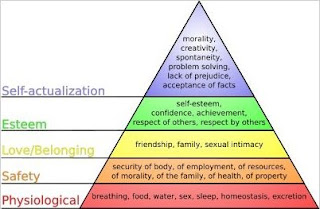
Abraham Maslow was a renowned anthropologist, best known for his concepts of the Heirarchy of Human Needs.

Maslow's hierarchy of needsHuman needs are grouped into five categories with various priorities. The lower ones have to be satisfied before the higher needs can act as motivators. A hungry programmer can hardly be motivated to write good code.

One is always shifting between these levels, satisfying multiple needs simultaneously.

The need for self-actualization is notoriously insatiable. "Ultimately happy" is how Maslow described it, which in itself sounds dubious. One is always left wanting for more.

Peter Drucker, another renowned man and a management guru, disagreed with one tenet of this heirarchy. His argument was that as a want approaches fulfillment, its capacity to reward, to act as an incentive, diminshes greatly, while its capacity to deter and act as a disincentive increases.

If you put the two points together - the one about self-actualization being a danger zone, and the diminishing returns from the lower needs - you will see how being only in the upper level of the hierarchy can be dangerous business. Here there is a high chance of ennui setting in, becoming blasé, and getting engulfed in a universal demotivation.

Being grounded in the lower levels is how one can stay focussed on the matter at hand, on real progress. Perhaps this is what Steve Jobs meant when he said "Stay hungry, stay foolish".

missing from google's index

A few days ago, one of my posts went missing from Google's index.
Which was rather strange because I had checked a few hours after publishing it that it was turning up in Google searches and Google Analytics had already started showing me hits on my blog because of that post.

After some digging around I found out that pages get taken out if a spam site links to them and then those pages are inspected in detail before putting them back in the index. And, if the page links to a spam site, it is taken out immediately and kept out. The latter turned out to be the cause of the post going missing. A spam site had left a "backlink" to my post and the post was inadvertently showing the link to the spam site. So I went and disabled all backlinks and the next day my post was showing up again!

The curious thing is that links in comments and backlinks/trackbacks usually have a rel=nofollow set. So I can't imagine why that backlink would have had any affect, but mysterious are the ways of Google. ;-)

Wednesday, October 8, 2008

marketing essentials

I recently spent a couple of hours doing an online Marketing Essentials course from Harvard Business School. Here is what I figured is the gist:

1. Understand the fundamental need behind demands.
2. Meet customer needs. Then exceed expectations.
3. Keep the conversation with the customer going.
4. Embrace change.
5. Everyone is a marketer.

All else derives from the above.

[Update: added item 5]

Thursday, October 2, 2008

post photos from Nokia E71 to wordpress directly

That is what I initially wanted to do. But this is more about post images or videos to any service for that matter, from any Nokia phone that can run Share Online. But I've tried this for images only from my E71, using Share Online 3.0 to a PHP service.

One day I saw something funny on the road, drew my phone, took aim, and shot. And was inspired enough to want to set up a proper photoblog for candid shots, for all of half a day! But regardless of me eventually not putting up a photoblog, I decided to poke around to see if I could do this in principle. And here is the result of a day and a half of hacking about.

Share Online 3.0 comes pre-installed on the E71, but without Flickr as an option. Their FAQ pointed me to the configuration file to get Flickr in to SO. If you overlook the junk in it (that is the flickr icon, base64-encoded), it looks very simple. Publishing uses the Atom Post protocol and WSSE for authentication. Tweak the media_options section to add video/3gpp or video/mp4 if you like. Change the endpoint_path to your own service and point configure_file_URL back to this configuration file. And you're done.

Here's how my configuration file looked like: http://umangjaipuria.com/share/uj_configuration_file.cfg.
Copy the file over to your phone and open it. The E71 automatically recognized it as a Share Online service configuration and added "UJ" as a new service. Options -> Add new account on the phone will let you specify a username and password for the service.

Every request by Share Online to your service will have authentication requirements. There will be a HTTP_X_WSSE parameter in the http headers. It will look like this:
UsernameToken Username="user1", PasswordDigest="4bHGUQyK7n/2JtGo/Tbjsr0aFww=", Nonce="NrS4fnwVWDB5QiIVR0qtIQ==", Created="2008-10-02T06:30:33Z".
Parse the string to extract the various name/values pairs. WSSE authentication can be checked (PHP code here) with:
$mydigest = base64_encode(pack("H*",
sha1(base64_decode($nonce).$created.$correct_password)));

The string in $mydigest should be the same as the PasswordDigest field in the WSSE string.

The first time Share Online tries to get a list of actions possible with this service (the Update Service operation under Options). This is the only GET operation and thus, for all GET requests (upon successful authentication, of course) my service returns:
<?xml version="1.0" encoding="utf-8"?>
<feed version="0.3" xmlns="http://purl.org/atom/ns#">
<link rel="service.post" href="http://myserver.com/nokia_shareonline.php" type="application/atom+xml" title="my photoblog">
<link rel="service.feed" href="http://myserver.com/feed/atom/" type="application/atom+xml" title="my photoblog">
<link rel="alternate" href="http://myserver.com/" type="text/html" title="my photoblog">
</feed>

With Content-Type set to application/atom+xml.
This tells Share Online where to make POST requests, amongst other things.

Now, about that POST request. Log the HTTP_RAW_POST_DATA to see what the request actually contains. The Atom protocol, again. But for some strange reason, Share Online makes two POST requests to submit a photo. The first one is just the image and in this case the post xml will have this element:
<standalone xmlns="http://sixapart.com/atom/typepad#">1</standalone>
The next one actually contains the description and the title and tags that you had entered in Share Online. I'm not sure how to correlate the two - I guess you have to assume that only one client (per authenticated user) is submitting at a time and sequential posts are related.

Since I saw the SixApart.com link above, I guess this is the exact Atom protocol Share Online uses: http://www.sixapart.com/developers/atom/protocol/.

This can be made into a nifty little Wordpress plugin. Perhaps some other day, if I decide to set up that photoblog after all.

So far, I'm loving my E71! If you have any cool tips or tricks to share about the phone, please leave me a comment. And check back again soon - I'm going to write about the apps I've set up on it.

Monday, September 29, 2008

running

Animals run for the love of running.

Children run for the love of running.

I wonder what happens to us human adults that running does not come naturally.
After overcoming the initial unwillingness and a few minutes into it, running is the most exhilarating activity of my day.

Saturday, September 6, 2008

elysium

(a bookmark of sorts)


Freude, schöner Götterfunken,
Tochter aus Elysium,
Wir betreten feuertrunken,
Himmlische, dein Heiligtum!

Deine Zauber binden wieder,
Was die Mode streng geteilt.
Alle Menschen werden Brüder,
Wo dein sanfter Flügel weilt.
Joy, beautiful spark of the gods,
Daughter of Elysium,
Touched with fire, we come,
Heavenly, your sanctuary!

Your sweet magic frees all others,
Held in Custom's rigid rings.
Beggars and princes become brothers,
In the haven of your wings.

The music, which completes the magic: http://www.youtube.com/watch?v=sqtZ_c3cyhE

Tuesday, September 2, 2008

tabs

Tabs (wikipedia article) have been around for quite a while. However, it was considered a breakthrough in browsing experience when Firefox popularized it and Safari and IE soon followed suit.

It must have made a big difference, at least for power users - all the clutter in the dektop taskbar was shifted into the tab-bar in the browser window.


object.render() ?
But if you look closely at it, tabs inside a browser window are hardly a UI phenomenon.
They are, in fact, the simplest representation of how the browser stores webpages in memory. If a browser needs to keep multiple pages open at the same time, there would be a list (linked? array?) of these pages. Each of these pages has a history - a list of web addresses that had been displayed on the page previously. You could go back (and even forward!) in time, one step at a time. Does that remind anyone of stack-like behaviour? Just pop from the "back" stack and push into the "forward" stack.


Browsers are creating a visual representation of their data rather than figuring out the right user experience first and then making their internals provide it. Definitely the wrong focus. Check out the "Experience is the Product" slides here.


What's Wrong?

Tabs and their history are so linear it is constraining. Why is a workspace defined only by a list of URLs open at a given point in time? Why is browsing history confined to a tab? Even the Back button is pointless: once you go back and click on a link, the part of the history that was under the Forward button vanishes - like branching out to another time dimension. "Back" makes sense within a particular web application like email or in the context of doing a search. But not as a mechanism to traverse history.


Go Non-Linear
So how do we get out of the confines of linearity imposed on our browsing?
For starters, get rid of tabs. And I don't mean go back to individual windows; I mean using tabs as they are meant to be - as containers for web pages instead of as focal points of browsing sessions.

Opening and closing of tabs should be seamless to the user - new ones opening up when required and older ones just fading away. As the sequence of browsing progresses, tabs that are not needed can be closed automatically. The unit of browsing should become the web application. For example, web search: I can have multiple tabs open while I'm searching for something and the "back" button should work consistently across them, allowing me to explore different websites at once, but always from the context of the search engine, jumping back and forth. The navigation needn't be tab-based as it is right now.

The History Too
"Back" for History is horribly broken. Browsing history can be delegated to a separate pane in the browser with items ranked either chronologically or by frequency or other ways that appear to the user as "views". A tree-like structure for history would be better than just a list of web pages. A powerful search on top of a longer window of history would fill in for the impossibility of capturing everything in a single view.


The browser can have two views - one where the user can see at a single glance the history and various browsing sessions currently in progress, and another where only a single browsing session is active and in focus. Currently browsers have only one view where a cluttered (and often barely usable) tab bar shows which tabs are open and the larger part of the screen shows one tab.

As browsers become more of a platform than an application, they are generating more interest and hopefully we'll see a lot more improvement, especially for the user experience.

[Update: As I finish writing this, Google Chrome is made available for download. They claim to have solved a lot of technical issues that people have been complaining about, and have made it open source. Hopefully the other browsers will have the good sense (and grace!) to build on top of this and improve the user experience.]

Saturday, August 30, 2008

experience is the product

The product is just a small part in the entire experience. Here's a great set of slides about creating the experience:


It's almost impossible to know the user's context. Ergo, build, measure, unbuild. Repeat. Of course, learn from other people's measurements.

Creating Passionate Users is another fantastic resource about creating the experience. It is an entire paradigm shift on how to think while designing a product.

Which brings me to Tufte - on the reading list for next weekend. His focus is specifically at data rather than a product, but it is eventually all the same. Will write about it later.

[Update: I later read this post and realised that the ideas I mention here seem disconnected: end-to-end experience, learning and gathering feedback from data, user-focus, and presenting data. Apologies - I was thinking two steps ahead of what I was writing. They are all connected and in a later post I will tie together the connections.]

Thursday, August 28, 2008

people

Are the real resource. The real investment. And the real returns.

Tuesday, August 26, 2008

courtesy call

I got my car serviced this time at a place closer home for the convenience - Pratham Motors on Sarjapur Road. Two days later it died on me, and was taken to the garage closest to where it had choked up.

Just so happened that the next day (or the day after that) someone from Pratham Motors called me up asking for feedback and how my car was doing. Extremely nice of them, except that they horribly screwed up handling a bad experience! I told them what had happened, not even sure of what to expect from them. All I got was "Sorry, Sir. If you want to complain please come down and meet our manager"!!! That got me really mad. If you don't really care, at least don't try and fake it!

There was absolutely no concern on the part of the customer care person. No questions about what was wrong, if they could do anything to make it better for me, no technician who would get back to me for more details. Basic courtesy I would expect. After all, I am trusting these chaps with my car.

Later I found out that my car was down because of adulterated petrol from a petrol pump. So it wasn't Pratham Motors' fault at all. But I am not going back there again. If in case something were truly wrong, I don't think they would know how to handle it.

Training and manuals can't prepare you for everything. It is important to build a culture that provides the right foundations.

Wednesday, August 6, 2008

conditioning

It has been a long time since I last blogged. It's not that I have been particularly busy (well, I have, but not so much that I didn't have half an hour to write) or that I haven't had much to say. The trick is to say it before the moment passes.

And that is true for so many other things!

I am subscribed to this National Geographic video podcast and the episode I was watching today (download it here) shows how a group of conservationists are trying to protect an endangered species of cranes from becoming extinct. They have a website too - operationmigration.org. These people breed cranes and teach them how to eat, how to fly, even migrating across the continent for the winter. The migratory path is apparently only in the memories of these birds, and handed down generation to generation. If a generation is lost, so is the collective memory.

What I found most interesting was the method employed by these scientists. They dress up to look almost like the cranes - well, close, and not human anyway - and play recordings of crane-speak to the little ones. No human is allowed to come near the cranes, nor are the dressed up scientists allowed to speak. The idea is to not let the cranes get used to humans since they are meant to be wild. They are taught flying by means of an ultra-light, white-painted aircraft that guides them through their migratory course too. And this aircraft is made to be a part of their environs ever since they are born, with the engine running often - so the cranes are used to it and the sound when the time comes for it to teach them flying.

I found it almost magical. You must see the video to experience it first hand.

What got me really thinking was the power of conditioning. It is absolute.
If we were to ever be subject to similar conditioning as these cranes, how would we realise it? What if we already were?


Monday, May 26, 2008

exploring space

This talk on rhythm, science, motion, discovery and dimensionality leaves one gasping. One wonders if there is brilliant music playing somewhere, that Michael Moschen is dancing to, which one cannot hear.


mobile 2.0

It does seem rather cool, given the amount of potential it has; and is perhaps the next logical step in evolution of social and information technology. But logic does not always rule supreme. A peek under the covers shows how different innovation on the mobile will be from what has been a given on the computer.

I was at the Mobile Monday meet some weeks back and it was quite an eye-opener in this hitherto unfamiliar area.

The mobile technology space is the anti-thesis of computer technology. It is a closed world of coteries of large and powerful companies.

Take the network carriers - they control content and distribution. Typical of large companies, they are short-sighted. If a third-party wants to make a service available for free, the carrier worries about losing revenue and lowering ARPUs (which is really the prime measure of their performance), and it has full control on how much it charges you or the user for using that service. Imagine having to PAY Comcast or BSNL or Airtel Broadband to use Facebook or Google Search or Wikipedia! Many startups in the mobile industry are just backend providers for services branded or pushed through exclusivity deals by the carriers. If you look at Airtel Live and look at some of the services there in detail, you will see what I mean. Even something as simple as getting a 5-digit number for interacting with your users means working with the carrier, all the carriers. It is like working with your ISP (and all the ISPs) to get a domain name, and the same domain on all of them!

One of the talks that day at MoMo was titled "Driving innovation for future mobile services". Not surprisingly, it was by a director at one of the largest carriers in the world (SingTel). He gave some case studies of how he and his team had helped startups come up with really useful services - next bus timings through SMS, etc. One of the things, though, that came up in the questions was how most of it was possible only because SingTel was pushing the ideas to the users and the carriers they owned (or had a stake in) etc. It is good to see the carriers trying to "drive innovation" but really, can the centralized model work for innovation? It didn't come across as if they were trying to enable innovation, but trying to get as large a pie of it as they could.

Handset makers play the other important role in this space. I haven't had much of a look-see there, so I desist from commenting. However, an anecdote - a friend asked me if I knew of any application on the mobile that was successful, and only one came to mind: SMS.

Innovation in the mobile space will have to be disruptive. Existing business models will have to be broken to shift focus from hegemonic corporations to users. That is the only way for it to grow as fast as the web as grown. What remains to be seen is who first plays the game to change the game.